Sustainable Materials Development for High-Entropy Alloys
暫譯: 高熵合金的可持續材料開發
Borode, Adeola Olaoluwa, Tshephe-Borode, Thato Sharon, Olubambi, Peter Apata
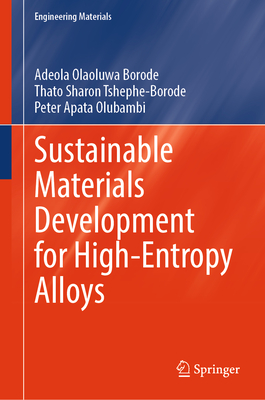
- 出版商: Springer
- 出版日期: 2026-07-17
- 售價: $8,370
- 貴賓價: 9.5 折 $7,951
- 語言: 英文
- 頁數: 367
- 裝訂: Hardcover - also called cloth, retail trade, or trade
- ISBN: 3032276268
- ISBN-13: 9783032276261
-
相關分類:
材料科學 Meterials
海外代購書籍(需單獨結帳)
相關主題

商品描述
This book provides innovative insights while also acting as a comprehensive guide for researchers, engineers, and graduate students in the fields of materials science, metallurgy, and environmental engineering. This book focuses on the innovative development of high-entropy alloys (HEAs), which are multi-principal element materials known for their exceptional strength, corrosion resistance, and thermal stability, while integrating sustainability into their design and application. The main topics include alloy design strategies, energy-efficient processing (including additive manufacturing), waste valorization (e.g., agro-waste reinforcements), microstructural engineering, advanced characterization, and applications in aerospace, automotive, and defense, culminating in a roadmap for scalable production. These topics are crucial for addressing resource scarcity, high production costs, and environmental impact in modern industries. Also, the book provides solutions to the problem of traditional HEA development's ecological footprint by offering a framework that leverages computational tools, circular economy principles, and low-cost materials, ensuring high-performance solutions align with global sustainability goals.
商品描述(中文翻譯)
本書提供創新的見解,同時作為材料科學、冶金學和環境工程領域的研究人員、工程師和研究生的綜合指南。本書專注於高熵合金(High-Entropy Alloys, HEAs)的創新發展,這些多主元素材料以其卓越的強度、耐腐蝕性和熱穩定性而聞名,同時將可持續性融入其設計和應用中。主要主題包括合金設計策略、能源效率加工(包括增材製造)、廢物增值(例如農業廢棄物增強材料)、微觀結構工程、先進表徵技術,以及在航空航天、汽車和國防領域的應用,最終形成可擴展生產的路線圖。這些主題對於解決現代工業中的資源稀缺、高生產成本和環境影響至關重要。此外,本書還提供了解決傳統高熵合金開發生態足跡問題的方案,通過提供一個利用計算工具、循環經濟原則和低成本材料的框架,確保高性能解決方案與全球可持續發展目標相一致。
作者簡介
Dr. Adeola Olaoluwa Borode is Research Fellow at the Centre for Nanoengineering and Advanced Materials, University of Johannesburg, South Africa, coordinating research on sustainable high-entropy alloys from scrap metals and electronic wastes for the master's program in sustainable advanced materials, with a Ph.D. in mechanical engineering from the University of Johannesburg (2022), an M.Eng. (2017), and a B.Eng. (2011) from Federal University of Technology, Akure, Nigeria. His research spans nanofluids, heat transfer, and machine learning or artificial intelligence-based modeling, with postdoctoral work focusing on sustainable HEAs, titanium alloy/composite design using spark plasma sintering and 3D printing, characterized by SEM/EDS and nanoindentation. As Lecturer in Engineering Metallurgy, he taught advanced engineering materials, welding technology, and material testing. His work on nanofluids and modeling with neural networks enhances material performance. Supervising students in corrosion and wear studies, he contributes to this book, marking his first authored work on sustainable HEAs.
Dr. Thato Sharon Tshephe-Borode is Senior Lecturer and Deputy Director of the Centre for Nanoengineering and Advanced Materials at the University of Johannesburg, South Africa. She earned her Ph.D. in engineering metallurgy from the University of Johannesburg (2024), M.Tech. (cum laude, 2013), B.Tech. (2012), and National Diploma (2011) in metallurgical engineering from Tshwane University of Technology. Her expertise encompasses microscopy, additive manufacturing, spark plasma sintering, nanomechanical properties, titanium alloys and composites, biomaterials, and electrochemical techniques. Awarded the Colour Award for B.Tech. (2012), Best Poster Presenter at the International Society of Electrochemistry (2013), TUT-CSIR scholarship (2012-2013), and multiple NRF grants, she has supervised master's students on high-entropy alloys from e-waste and related topics. With over 20 peer-reviewed publications, including her Ph.D. thesis on 3D-printed zirconia-reinforced alloys, she co-authors this book, advancing sustainable materials research.
Prof. Peter Apata Olubambi is Professor in the Department of Engineering Metallurgy at the University of Johannesburg, South Africa, where he is also Head of the Centre for Nanoengineering and Advanced Materials (CeNAM). With a Ph.D. in metallurgical engineering from the University of the Witwatersrand (2008), and M.Eng. and B.Eng. degrees from Federal University of Technology, Akure, Nigeria, he specializes in alloy design, nanomaterials, and advanced material processing. He currently leads and coordinates the Master's of Sustainable Advanced Materials (research and coursework) within the Faculty of Engineering and the Built Environment. His research, with over 300 peer-reviewed publications, 9,000+ citations, and an h-index of 48, focuses on lightweight alloys for aerospace and biomedical applications. He is recognized among the world's top 2% scientists (2022-2025) by Stanford University and Elsevier for his cutting-edge advancements in Material Science.
作者簡介(中文翻譯)
Dr. Adeola Olaoluwa Borode 是南非約翰尼斯堡大學納米工程與先進材料中心的研究員,負責協調從廢金屬和電子廢物中提取可持續高熵合金的研究,並參與可持續先進材料碩士課程。他於約翰尼斯堡大學獲得機械工程博士學位(2022年),並於尼日利亞阿庫雷聯邦科技大學獲得碩士(2017年)和學士(2011年)學位。他的研究範疇包括納米流體、熱傳遞以及基於機器學習或人工智慧的建模,博士後研究專注於可持續高熵合金、使用火花等離子燒結和3D列印設計鈦合金/複合材料,並通過掃描電子顯微鏡(SEM)/能量色散光譜(EDS)和納米壓痕進行表徵。作為工程冶金學講師,他教授先進工程材料、焊接技術和材料測試。他在納米流體和使用神經網絡建模方面的工作提升了材料性能。指導學生進行腐蝕和磨損研究,他為本書作出貢獻,這是他首次以作者身份撰寫的有關可持續高熵合金的作品。
Dr. Thato Sharon Tshephe-Borode 是南非約翰尼斯堡大學納米工程與先進材料中心的高級講師及副主任。她於約翰尼斯堡大學獲得工程冶金博士學位(2024年),並在特萬尼科技大學獲得優等碩士學位(2013年)、學士學位(2012年)及國家文憑(2011年)於冶金工程領域。她的專業涵蓋顯微鏡學、增材製造、火花等離子燒結、納米機械性質、鈦合金及複合材料、生物材料和電化學技術。她曾獲得B.Tech.(2012年)顏色獎、國際電化學學會最佳海報演講者(2013年)、TUT-CSIR獎學金(2012-2013年)及多項NRF資助,並指導碩士生研究來自電子廢物的高熵合金及相關主題。她擁有超過20篇同行評審的出版物,包括她的博士論文,該論文探討3D列印的鋯氧化物增強合金,她共同撰寫本書,推進可持續材料研究。
Prof. Peter Apata Olubambi 是南非約翰尼斯堡大學工程冶金系的教授,同時也是納米工程與先進材料中心(CeNAM)的主任。他於威特沃特斯蘭大學獲得冶金工程博士學位(2008年),並在尼日利亞阿庫雷聯邦科技大學獲得碩士和學士學位。他專注於合金設計、納米材料和先進材料加工。目前,他負責並協調工程與建築環境學院的可持續先進材料碩士(研究和課程)。他的研究擁有超過300篇同行評審的出版物,引用次數超過9,000次,h指數為48,專注於航空航天和生物醫學應用的輕量合金。他因在材料科學領域的前沿進展而被史丹佛大學和Elsevier認定為全球前2%的科學家(2022-2025年)。