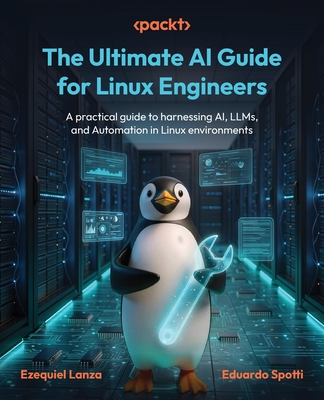
The Ultimate AI Guide for Linux Engineers: A practical guide to harnessing AI, LLMs, and Automation in Linux environments
暫譯: Linux 工程師的終極 AI 指南:在 Linux 環境中運用 AI、LLM 和自動化的實用指南
Lanza, Ezequiel, Spotti, Eduardo
- 出版商: Packt Publishing
- 出版日期: 2026-05-29
- 售價: $1,850
- 貴賓價: 9.5 折 $1,757
- 語言: 英文
- 頁數: 330
- 裝訂: Quality Paper - also called trade paper
- ISBN: 1806664232
- ISBN-13: 9781806664238
-
相關分類:
AI Coding、Linux
立即出貨 (庫存=1)
相關主題

商品描述
Learn how to integrate AI into Linux environments with real-world automation, observability, and scalable deployment techniques for modern infrastructure teams
Key Features:
- Apply AI to Linux, from core concepts to production-ready deployments at scale
- Build intelligent automation using LLMs, RAG, and AI agents for monitoring, troubleshooting, and system administration
- Deploy secure, scalable AI workloads with Docker, Kubernetes, and cloud-native best practices
Book Description:
Unlock the power of artificial intelligence to transform Linux infrastructure and operations.
The Ultimate AI Guide for Linux Engineers is a practical, hands-on handbook for applying AI to real-world Linux systems. You will demystify AI, machine learning, and large language models (LLMs) in practice, prepare AI-ready Linux environments for CPU and GPU workloads, and work with containers and essential open-source frameworks such as PyTorch, Hugging Face Transformers, LangChain, and OpenVINO.
Moving into real operational use cases, you will build AI agents and agentic workflows to automate system administration, integrate LLMs into monitoring and troubleshooting pipelines, and apply Retrieval-Augmented Generation (RAG) to query logs, documentation, and internal knowledge bases. You will also enhance observability and incident response with intelligent automation.
Finally, you will learn how to deploy and scale AI services using Docker, Kubernetes, and cloud-native architectures, implement security and privacy guardrails, and design reliable AI-driven workflows for enterprise Linux environments.
By the end, you will have a practical framework to integrate AI into Linux workflows securely and at scale.
What You Will Learn:
- Optimize Linux kernels and GPUs for AI workloads
- Orchestrate LLM pipelines across distributed systems
- Design agentic workflows for autonomous operations
- Implement RAG over logs and internal knowledge graphs
- Embed AI into observability and incident triage
- Deploy scalable AI microservices on Kubernetes
- Enforce security, isolation, and model guardrails
Who this book is for:
This book is for Linux engineers, system administrators, DevOps professionals, SREs, and platform engineers who want to integrate AI into real-world infrastructure and operations. Prior hands-on experience with Linux, the command line, and basic system administration is expected. Some familiarity with containers (Docker), Kubernetes, and scripting (Bash or Python) would be helpful. Prior AI or machine learning knowledge is beneficial but not required, as core concepts are explained in practical Linux terms.
Table of Contents
- Why AI Matters for Linux Engineers
- Demystifying AI, ML, and LLMs for Linux Engineers
- Preparing an AI-Ready Linux Environment
- Essential Open Source Frameworks for Linux Engineers
- Automating Linux Operations with AI Assistance
- Building Autonomous Linux Operations Agents
- Monitoring and Troubleshooting Linux Systems with LLMs
- Retrieval-Augmented Generation (RAG) for Linux Knowledge and Logs
- Deploying and Scaling AI Services on Linux and Kubernetes
- Security, Privacy, and Guardrails for Production AI
- Looking Ahead: The Future of AI-Driven Linux Workflows