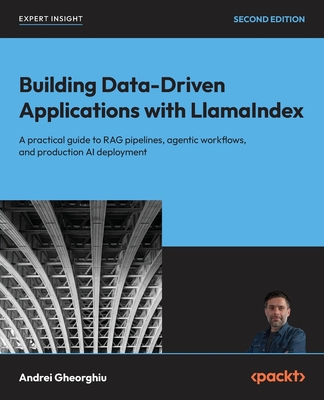
Building Data-Driven Applications with LlamaIndex - Second Edition: A practical guide to RAG pipelines, agentic workflows, and production AI deploymen
暫譯: 使用 LlamaIndex 建立數據驅動應用程式 - 第二版:實用指南,涵蓋 RAG 管道、代理工作流程及生產環境中的 AI 部署
Gheorghiu, Andrei
- 出版商: Packt Publishing
- 出版日期: 2026-05-29
- 售價: $1,720
- 貴賓價: 9.5 折 $1,634
- 語言: 英文
- 頁數: 640
- 裝訂: Quality Paper - also called trade paper
- ISBN: 1806021854
- ISBN-13: 9781806021857
-
相關分類:
AI Coding
海外代購書籍(需單獨結帳)
相關主題

商品描述
Build data-grounded AI applications with LlamaIndex through hands-on examples covering RAG pipelines, agentic workflows, multi-agent systems, prompt engineering, evaluation, and deployment with Python and Streamlit.
Free with your book: DRM-free PDF version + access to Packt's next-gen Reader*
Key Features:
- Build complete RAG pipelines from ingestion to deployment with practical working examples
- Design agentic workflows and multi-agent architectures for production-ready AI systems
- Develop a hands-on project from a simple LLM app to a deployed AI-powered web application
- Run everything locally with Ollama - no API keys or costs required
Book Description:
Large language models can generate impressive responses, but they often struggle with outdated knowledge, limited access to proprietary data, hallucinations, and inconsistent reasoning in real-world applications. LlamaIndex addresses these challenges through RAG, enabling developers to connect LLMs with external data sources and build more reliable AI applications.
This fully updated second edition reflects the latest evolution of the LlamaIndex ecosystem. You will learn how to ingest and parse data from multiple sources, build optimized indexes, and implement advanced retrieval strategies for high-quality RAG applications.
*Email sign-up and proof of purchase required
The book introduces modern agentic AI patterns using LlamaIndex Workflows, chat engines, agents, and multi-agent orchestration. You will also explore observability and RAG evaluation, prompt engineering best practices, and deployment strategies using Streamlit.
Throughout the book, you will build a practical Contract Review Expert application that evolves chapter by chapter from a simple query engine into a fully deployed AI-powered web application. You will also learn how to use enterprise tooling such as LlamaParse alongside open source alternatives such as LiteParse.
By the end of this book, you will be able to design, build, evaluate, and deploy scalable LlamaIndex applications grounded in your own data.
What You Will Learn:
- Understand the LlamaIndex ecosystem and core use cases
- Master techniques to ingest and parse data from diverse sources
- Build optimized indexes for RAG applications
- Query data using retrievers, postprocessors, and response synthesizers
- Design agentic workflows and multi-agent systems
- Deploy AI applications with Python and Streamlit
- Evaluate and tune your RAG implementation using observability tools and key metrics
- Apply prompt engineering best practices to improve AI responses
Who this book is for:
This book is for Python developers with a basic knowledge of LLMs who want to build interactive, generative, and agentic AI applications grounded in proprietary data. Experienced developers and AI practitioners will also benefit from the advanced techniques covered like agentic workflows, multi-agent orchestration, RAG evaluation, and enterprise tooling. A working knowledge of Python and familiarity with generative AI concepts is assumed.
The book is aimed at those with a basic knowledge of Python and working knowledge in developing applications using Generative AI models.
Table of Contents
- Understanding Large Language Models
- LlamaIndex: The Hidden Jewel - An Introduction to the LlamaIndex Ecosystem
- Kickstarting Your Journey with LlamaIndex
- Ingesting Data into Our RAG Workflow
- Indexing with LlamaIndex
- Querying Our Data, Part 1 - Context Retrieval
- Querying Our Data, Part 2 - Postprocessing and Response Synthesis
- Building Faster and Smarter with Workflows
(N.B. Please use the Read Sample option to see further chapters)