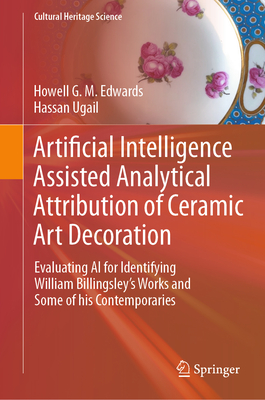
Artificial Intelligence Assisted Analytical Attribution of Ceramic Art Decoration: Evaluating AI for Identifying William Billingsley's Works and Some
暫譯: 人工智慧輔助陶瓷藝術裝飾的分析歸因:評估AI在識別威廉·比林斯利作品中的應用
Edwards, Howell G. M., Ugail, Hassan
相關主題

商品描述
商品描述(中文翻譯)
本書回顧了一種基於人工智慧的方法論,該方法用於藝術品的特徵描述及將作品歸屬於特定藝術家的過程。迄今為止,這類方法主要應用於油畫,因為可以通過紅外線(IR)和X光成像,以及對顏料、黏合劑和樹脂的化學分析,獲得支持的科學證據。
本書探討的新方法將這些技術適應於陶瓷裝飾及其所使用的特殊顏料,這些顏料必須能夠承受高達1000°C的窯燒溫度。與油畫一樣,陶瓷裝飾藝術家的藝術性傳統上由藝術專家和鑑賞家評估,他們之前並未考慮相關的科學證據,因此主要依賴於風格判斷。
本卷針對這一空白,專注於著名陶瓷藝術家William Billingsley的作品,他在18世紀末至19世紀初的最後二十年中,開始於德比(Derby)等幾個製造廠的瓷器上作畫,並後來在Nantgarw建立了自己的工廠。許多Billingsley的藝術作品如今收藏於全球主要博物館。
原則保持不變:人工智慧程序需要訓練計算機識別Billingsley的經過驗證的作品,然後檢查其他歸屬於他的作品,以評估其歸屬的正確性,同時也將他的作品與當代藝術家如Moses Webster、William Pegg和Leonard Lead的作品進行比較。
作者簡介
Howell Edwards is Professor Emeritus of Molecular Spectroscopy at the University of Bradford. He studied Chemistry at Jesus College, Oxford, completing his B.A. and B.Sc. before undertaking doctoral work in Raman spectroscopy. He later became a Research Fellow at Jesus College, Cambridge. After joining the University of Bradford as a Lecturer in Structural and Inorganic Chemistry, he became Head of the Department of Chemical and Forensic Sciences and was awarded a Personal Chair in Molecular Spectroscopy in 1996.
His career in spectroscopy has been recognised through major international awards, including the Sir Harold Thompson Award, the Charles Mann Award, the Emanuel Boricky Medal, and the Norman Sheppard Award. He has published more than 1,420 research papers on Raman spectroscopy and the analysis of materials in art, archaeology, and forensic science. He has also maintained a long-standing interest in the porcelains of William Billingsley, especially those made at Derby, Nantgarw, and Swansea.
Professor Edwards is the author of eleven books on ceramics, porcelain, and cultural heritage science, including Swansea and Nantgarw Porcelains: A Scientific Reappraisal; Nantgarw and Swansea Porcelains: An Analytical Perspective; Porcelain to Silica Bricks; 18th and 19th Century Porcelain Analysis; Porcelain Analysis and Its Role in the Forensic Attribution of Ceramic Specimens; Raman Spectroscopy in Cultural Heritage Preservation; Armorial Porcelain: The Genesis; Welsh Armorial Porcelains; The Pendock-Barry Porcelain Service; The Farnley Hall Service; and Blue by Fire. His forthcoming book, A-Marked Porcelains: Their History, Chemistry, Decoration and Attribution, co-authored with Ross and Gael Ramsay, is scheduled for 2026. He also serves as Honorary Scientific Adviser to the de Brecy Trust on the scientific evaluation of artworks.
Hassan Ugail is Professor of Visual Computing at the University of Bradford and Director of the Centre for Visual Computing and Intelligent Systems. With over three decades of experience in computer science, applied mathematics, and machine learning, his work centres on visual analysis, pattern recognition, and AI-enabled decision support.
He is internationally recognised for pioneering the use of artificial intelligence in the analysis and attribution of historical artworks. His research has shown how deep learning and handcrafted image features can detect subtle stylistic signatures in paintings and decorative art. He is especially known for his AI-assisted attribution studies on Raphael, including the widely reported analysis of the Madonna della Rosa, which helped establish computational connoisseurship as a credible method in art history.
This volume extends that work into ceramic art, applying similar methods to the decorated porcelain of William Billingsley and his contemporaries. By combining deep learning, one-class classification, and handcrafted image analysis, it introduces new tools for attribution and authentication in an area traditionally dominated by connoisseurship and physical examination.
Beyond cultural heritage, Professor Ugail has led significant research in biometrics, forensic imaging, healthcare AI, and public-sector decision support. He has worked with NHS Blood and Transplant and collaborated with teams at Oxford and Newcastle on NIHR-funded projects in medical image analysis and organ quality assessment. He has undertaken biometric research with Dubai Police and advised the United Nations on AI implementation. His work has generated patents, supported university spin-outs, and attracted funding from NIHR, EPSRC, UKRI, Innovate UK, DASA, DSTL, and the UK Ministry of Defence. His achievements have been recognised by the University of Bradford Vice-Chancellor's Award for Excellence in Knowledge Transfer (2010, 2019) and the Maldives National Award for Innovation (2011).
作者簡介(中文翻譯)
霍威爾·愛德華茲是布拉德福德大學分子光譜學的名譽教授。他在牛津大學耶穌學院學習化學,獲得文學士(B.A.)和理學士(B.Sc.)學位後,進行拉曼光譜學的博士研究。之後,他成為劍橋大學耶穌學院的研究員。加入布拉德福德大學擔任結構與無機化學講師後,他成為化學與法醫科學系的系主任,並於1996年獲得分子光譜學的個人講座。
他的光譜學職業生涯獲得了多項國際重要獎項的認可,包括哈羅德·湯普森爵士獎、查爾斯·曼獎、伊曼紐爾·博里基獎章和諾曼·謝帕德獎。他已發表超過1,420篇有關拉曼光譜學及藝術、考古學和法醫科學材料分析的研究論文。他對威廉·比林斯利的瓷器保持長期興趣,特別是那些在德比、南加爾和斯旺西製作的瓷器。
愛德華茲教授是十一本有關陶瓷、瓷器和文化遺產科學的書籍的作者,包括《斯旺西與南加爾瓷器:科學重評估》;《南加爾與斯旺西瓷器:分析視角》;《瓷器到矽磚》;《18世紀和19世紀瓷器分析》;《瓷器分析及其在陶瓷標本法醫歸屬中的角色》;《文化遺產保存中的拉曼光譜學》;《紋章瓷器:起源》;《威爾士紋章瓷器》;《彭多克-巴里瓷器服務》;《法恩利霍爾服務》;以及《火焰藍》。他即將出版的書籍《A-Marked Porcelains: Their History, Chemistry, Decoration and Attribution》,由羅斯和蓋爾·拉姆齊共同撰寫,預定於2026年出版。他還擔任德布雷西信託的榮譽科學顧問,負責藝術品的科學評估。
哈桑·烏蓋爾是布拉德福德大學視覺計算教授及視覺計算與智能系統中心的主任。擁有超過三十年的計算機科學、應用數學和機器學習經驗,他的工作重點在於視覺分析、模式識別和人工智能支持的決策支持。
他因在歷史藝術品的分析和歸屬中開創性地使用人工智能而受到國際認可。他的研究顯示,深度學習和手工製作的圖像特徵可以檢測到畫作和裝飾藝術中的微妙風格特徵。他特別以對拉斐爾的人工智能輔助歸屬研究而聞名,包括對《玫瑰聖母》的廣泛報導分析,這有助於確立計算鑑賞學作為藝術史中的一種可信方法。
本卷將該工作擴展到陶瓷藝術,對威廉·比林斯利及其 contemporaries 的裝飾瓷器應用類似的方法。通過結合深度學習、一類分類和手工圖像分析,它為傳統上由鑑賞學和實體檢查主導的領域引入了新的歸屬和驗證工具。
除了文化遺產,烏蓋爾教授在生物識別、法醫成像、醫療保健人工智能和公共部門決策支持方面也領導了重要研究。他曾與英國國民健康服務血液與移植部門合作,並與牛津和紐卡斯爾的團隊在NIHR資助的醫學影像分析和器官質量評估項目中合作。他還與迪拜警方進行生物識別研究,並就人工智能實施向聯合國提供建議。他的工作產生了專利,支持了大學的創業公司,並吸引了來自NIHR、EPSRC、UKRI、Innovate UK、DASA、DSTL和英國國防部的資金。他的成就獲得了布拉德福德大學副校長知識轉移卓越獎(2010年、2019年)和馬爾代夫國家創新獎(2011年)的認可。


