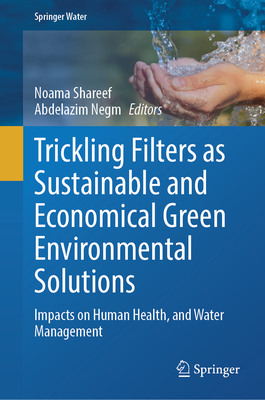
Trickling Filters as Sustainable and Economical Green Environmental Solutions: Impacts on Human Health, and Water Management
暫譯: 作為可持續且經濟的綠色環境解決方案的滲流濾床:對人類健康和水資源管理的影響
Shareef, Noama, Negm, Abdelazim
相關主題

商品描述
This book offers a clear, authoritative, and practice-oriented guide to modern trickling filter technology as a best practice, positioning it as an ecological, economical, and resilient solution for municipal and industrial wastewater treatment. Bridging more than a century of innovation, the book demonstrates why trickling filters remain a cornerstone of sustainable biological treatment systems worldwide.
Through rigorous analysis and applications, the book explains the innovation in fundamental principles of biofilm systems, highlighting their efficiency, robustness, and role in achieving high-performance biological purification under diverse climatic and operational conditions. It critically examines classical and modern design philosophies, operational strategies, and process optimization techniques for modern-generation trickling filter systems.
The book provides in-depth coverage of integrated treatment approaches, combining trickling filter with activated sludge configurations applied worldwide, as well as novel hybrid systems that incorporate adsorption processes and bioaugmentation. Special attention is given to the removal of emerging contaminants and micropollutants, supported by pilot-scale studies and operational performance data
Industrial applications are addressed through detailed discussions of biotower systems for food and beverage wastewater, while decentralized, resource-efficient solutions are explored through combinations of trickling filter anaerobic digestion. The book further evaluates design parameters, operational costs, performance indicators, and future development pathways, linking trickling filter technology to circular economy concepts, water reuse strategies, and sustainable development goals, with relevance to the MENA region.
By reviewing theoretical models and current research trends, the book connects engineering practice with public health protection and sustainable water governance. It serves as an essential reference for academics, practicing engineers, decision-makers, regulators, and postgraduate students, and is equally valuable for professionals engaged in environmental engineering and water management worldwide.
商品描述(中文翻譯)
這本書提供了一個清晰、權威且以實踐為導向的現代滴流濾池技術指南,將其定位為市政和工業廢水處理的生態、經濟和韌性解決方案。這本書跨越了一個多世紀的創新,展示了為什麼滴流濾池仍然是全球可持續生物處理系統的基石。
通過嚴謹的分析和應用,這本書解釋了生物膜系統基本原則的創新,突顯了它們在多樣氣候和操作條件下實現高效能生物淨化的效率、穩健性和角色。它批判性地檢視了現代滴流濾池系統的經典與現代設計理念、操作策略和過程優化技術。
本書深入探討了綜合處理方法,結合了全球應用的滴流濾池與活性污泥配置,以及結合吸附過程和生物增強的新型混合系統。特別關注新興污染物和微污染物的去除,並以試點規模研究和操作性能數據作為支持。
工業應用通過對食品和飲料廢水的生物塔系統進行詳細討論來解決,而去中心化的資源高效解決方案則通過滴流濾池與厭氧消化的組合進行探索。本書進一步評估設計參數、運營成本、性能指標和未來發展路徑,將滴流濾池技術與循環經濟概念、水資源重用策略和可持續發展目標聯繫起來,並與中東和北非地區相關。
通過回顧理論模型和當前研究趨勢,本書將工程實踐與公共健康保護和可持續水治理相連接。它是學術界、實踐工程師、決策者、監管機構和研究生的重要參考資料,對於全球從事環境工程和水資源管理的專業人士同樣具有價值。
作者簡介
Dr.-Ing. Noama Shareef is a Senior Water and Environmental Engineering Expert with over 15 years of experience in the German and international water sectors. She holds a Ph.D. in Water Management from University of Rostock, Germany, in addition to Bachelor's, Diploma, and master's degrees in civil-Environmental Engineering. Her expertise covers wastewater and sludge treatment, including WWTP and sludge unit design and evaluation, O&M, process optimization, biofilm systems, nutrient recovery, and reuse of treated water and sludge, supported by strong experience in process engineering, sanitation systems, and technical consultancy. Dr. Shareef has worked extensively across the MENA region with international development programs supported by KfW, USAID, GIZ, SIWI, SIDA, ACWUA, and the Arab League, contributing to water sector reform, infrastructure development, and sludge management strategies. She has led performance assessments of sludge treatment units, developed sludge management and O&M frameworks, and delivered capacity-building programs for utilities and operators. Her experience also includes served as a Water Policy Advisor with a European Water Association (EWA) representing over 1,400 members, strengthening her skills in business planning and strategic development. Dr. Shareef is a licensed Training Trainers (ToT) in wastewater O&M, water quality management, energy efficiency, water integrity, reuse, and decentralized wastewater systems. She is an Editor with Springer, a speaker at high-level international conferences, and a licensed Arbitration Consultant in International Commercial Arbitration.
Prof. Dr. Eng. Abdelazim Negm is a Professor of Hydraulics (and Water Resources) at the Faculty of Engineering, Zagazig University, Egypt, a position he has held since 2004. He previously served as Vice Dean of the Faculty of Engineering at Zagazig University (2008-2011) and as Head of the Environmental Engineering Department at the Egypt-Japan University of Science and Technology (E-JUST) from 2013 to 2016. Since 2006, he has been actively involved in numerous international and local and international research-funded projects, leading several of them. Prof. Negm has published more than 400 papers in national and international journals and conference proceedings and has contributed to over 50+ book chapters published by Springer. A number of his publications have received best paper awards. He has edited more than 60 books with Springer and has extensive experience in academic publishing and peer review. He has served on the scientific and organizing committees of many international conferences and has participated in more than 105+ conferences worldwide, including delivering several keynote lectures. He is a reviewer for over 50 international scientific journals indexed in Scopus and Web of Science. His editorial roles include Editor-in-Chief of the Egyptian International Journal of Engineering Sciences and Technology (2017-2020), editor of the Euro-Mediterranean Journal of Environmental Integration (Springer), and associate editor of journals published by Elsevier. He is also a member of the editorial boards of several international journals and an editorial board member of the Springer Handbook of Environmental Chemistry book series since 2019. In addition, he served as Head of the Permanent Scientific Committee on Water Resources at the Supreme Council of Egyptian Universities (cycle 13) and as a member in cycles 12 and 15. He is listed in major international biographical directories, including Marquis Who's Who in the World and the International Biographical Centre's Outstanding Intellectuals of the 21st Century.
作者簡介(中文翻譯)
Dr.-Ing. Noama Shareef 是一位資深水資源與環境工程專家,擁有超過 15 年的德國及國際水務領域經驗。她擁有德國羅斯托克大學的水資源管理博士學位,以及土木環境工程的學士、文憑和碩士學位。她的專業涵蓋廢水和污泥處理,包括污水處理廠(WWTP)和污泥單元的設計與評估、運營與維護(O&M)、過程優化、生物膜系統、養分回收以及處理水和污泥的再利用,並擁有強大的過程工程、衛生系統和技術諮詢經驗。Dr. Shareef 在中東和北非(MENA)地區廣泛參與國際發展計劃,這些計劃由 KfW、USAID、GIZ、SIWI、SIDA、ACWUA 和阿拉伯聯盟支持,為水務部門改革、基礎設施發展和污泥管理策略做出了貢獻。她主導了污泥處理單元的性能評估,開發了污泥管理和運營維護框架,並為公用事業和操作人員提供了能力建設計劃。她的經驗還包括擔任歐洲水協會(EWA)的水政策顧問,該協會代表超過 1,400 名成員,增強了她在商業規劃和戰略發展方面的技能。Dr. Shareef 是廢水運營與維護、水質管理、能源效率、水完整性、再利用和分散式廢水系統的授權培訓講師(ToT)。她是 Springer 的編輯,並在高層國際會議上發表演講,還是國際商業仲裁的授權仲裁顧問。
Prof. Dr. Eng. Abdelazim Negm 是埃及扎卡齊格大學工程學院的水力學(及水資源)教授,自 2004 年以來一直擔任此職位。他曾於 2008 至 2011 年擔任扎卡齊格大學工程學院副院長,並於 2013 至 2016 年擔任埃及-日本科技大學(E-JUST)環境工程系主任。自 2006 年以來,他積極參與多個國際及本地研究資助項目,並主導其中幾個項目。Negm 教授在國內外期刊和會議論文集中發表了超過 400 篇論文,並為 Springer 出版的 50 多個書章做出了貢獻。他的多篇出版物獲得最佳論文獎。他編輯了超過 60 本書籍,並在學術出版和同行評審方面擁有豐富的經驗。他曾在多個國際會議的科學和組織委員會任職,並參加了超過 105 次的全球會議,包括多次主題演講。他是超過 50 本國際科學期刊的審稿人,這些期刊均已在 Scopus 和 Web of Science 中索引。他的編輯角色包括埃及國際工程科學與技術期刊的主編(2017-2020)、歐洲-地中海環境整合期刊(Springer)的編輯,以及 Elsevier 出版的期刊的副編輯。他還是幾本國際期刊的編輯委員會成員,自 2019 年以來擔任 Springer 環境化學手冊系列的編輯委員會成員。此外,他曾擔任埃及大學最高委員會水資源常設科學委員會的主任(第 13 屆),並在第 12 屆和第 15 屆任職。他被列入主要國際傳記名錄,包括《世界名人錄》(Marquis Who's Who in the World)和《21 世紀傑出知識分子》(International Biographical Centre's Outstanding Intellectuals of the 21st Century)。