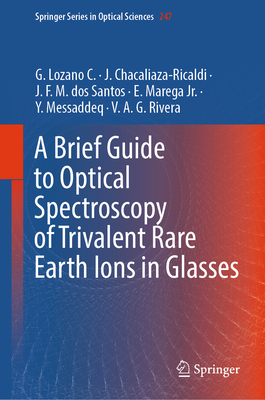
A Brief Guide to Optical Spectroscopy of Trivalent Rare Earth Ions in Glasses
暫譯: 三價稀土離子在玻璃中的光學光譜簡明指南
Lozano C., G., Chacaliaza-Ricaldi, J., Dos Santos, J. F.
- 出版商: Springer
- 出版日期: 2026-05-15
- 售價: $7,180
- 貴賓價: 9.5 折 $6,821
- 語言: 英文
- 頁數: 140
- 裝訂: Hardcover - also called cloth, retail trade, or trade
- ISBN: 3032185009
- ISBN-13: 9783032185006
-
相關分類:
光電子學 Photonics
海外代購書籍(需單獨結帳)
相關主題

商品描述
This book provides a concise and accessible guide to the spectroscopic measurement and analysis of trivalent rare-earth ions in glasses. As the demand for faster telecommunications, more efficient lasers, and smarter optical sensors accelerates, rare-earth-doped glasses have become a cornerstone of modern photonics and emerging quantum technologies. Fully harnessing their potential, however, requires a deep understanding of their spectroscopic behavior. Spectroscopy of rare-earth doped glasses is a vital resource for researchers, engineers, and advanced students moving from material fabrication to functional device design. This book offers a rigorous and practical journey through the essential characterization techniques that reveal the inner workings of these versatile materials.
Inside, readers will find detailed coverage of foundational principles such as absorption and luminescence spectra and decay lifetimes, which are used to probe the energy-level structure and dynamics of rare-earth ions. Advanced characterization techniques are also presented, including leveraging Judd-Ofelt theory to predict radiative properties, applying the Z-scan method for nonlinear-optical analysis, and utilizing emission-intensity ratios for precision optical thermometry. Practical data analysis is highlighted as well, moving beyond theory with step-by-step methodologies for interpreting spectroscopic results: calculating emission cross-sections, modeling energy transfer, and performing colorimetric analysis. Cutting-edge applications demonstrate how characterization outcomes directly inform the design and optimization of photonic integrated circuits, optical amplifiers, laser systems, and nanophotonic devices. By seamlessly integrating theory, experiment, and data processing, this book equips readers not only to collect data but to derive meaningful, actionable conclusions. It is an indispensable guide for anyone committed to advancing optical materials research and shaping the next generation of quantum photonic technologies.商品描述(中文翻譯)
這本書提供了一個簡明易懂的指南,介紹三價稀土離子在玻璃中的光譜測量和分析。隨著對更快的電信、更高效的激光和更智能的光學傳感器需求的加速,掺稀土的玻璃已成為現代光子學和新興量子技術的基石。然而,充分發揮其潛力需要對其光譜行為有深入的理解。《掺稀土玻璃的光譜學》是研究人員、工程師和進階學生從材料製造轉向功能性設備設計的重要資源。本書提供了一個嚴謹且實用的旅程,涵蓋揭示這些多功能材料內部運作的基本特徵化技術。
在書中,讀者將找到對基礎原理的詳細介紹,例如吸收和發光光譜及衰變壽命,這些原理用於探測稀土離子的能級結構和動力學。書中還介紹了先進的特徵化技術,包括利用Judd-Ofelt理論預測輻射性質、應用Z掃描方法進行非線性光學分析,以及利用發射強度比進行精確的光學熱測量。實用的數據分析也得到了強調,超越理論,提供逐步的方法論來解釋光譜結果:計算發射截面、建模能量轉移和進行比色分析。前沿應用展示了特徵化結果如何直接影響光子集成電路、光學放大器、激光系統和納米光子設備的設計和優化。通過無縫整合理論、實驗和數據處理,本書不僅使讀者能夠收集數據,還能得出有意義且可行的結論。這是一本對於任何致力於推進光學材料研究和塑造下一代量子光子技術的人來說不可或缺的指南。
作者簡介
G. Lozano C. earned his BSc in physics from the UNFV, Peru 2017. Master a PhD from the IFSC-USP, SP-Brazil, 2020 and 2025, respectively. He was a visiting researcher at the COPL-ULAVAL 2022. He is currently a postdoctoral at the IQSC-USP. His current research is centered on the purification of tellurite glasses.
J.Y.A. Chacaliaza R. earned a BSc. in Physics from the UNMSM, Perú. MSc. in Physics from the IFSC-USP, SP-Brazil. Currently is PhD fellow at the IFSC with cotutelle at the Complutense University of Madrid, Spain. He is now working in quantum optics based on rare-earth ions and cavity quantum electrodynamics.
Jéssica F. M. dos Santos is a physicist with a PhD in Materials Science and Engineering from USP, Brazil. Her research focuses on condensed matter physics and the spectroscopic investigation of rare-earth and transition-metal-doped materials for applications in photonics and plasmonics. She is currently a postdoctoral researcher at the CEPOF-USP, where she studies light-matter interaction in plasmonic surfaces.
Y. Messaddeq is a Professor at the Department of Physics, Physical Engineering and Optics at the ULAVAL, QC-Canada. His research program focuses on the development of new glass and nanostructured materials to give them unprecedented properties, primarily to produce specialty and multifunctional optical fibers. Leading a cutting-edge laboratory at the COPL. In 2010, he earned the prestigious Canada Excellence Research Chair in Enabling Photonic Innovations. In 2016, He received the Excellence funding research program SPEC from SP-Brazil. In 2018, the Government of Canada awarded him the Canadian Brockhouse Prize for Interdisciplinary Research in Science and Engineering. In 2020, he received the Varshneya Glass Technology Lecture Award from the American Ceramic Society for his contributions to the field of glass technology and benefit to mankind. He has received several distinctions, including the Specialty Optical Fibers Award for Telecommunication, the STA Fellowship on Optical Fibers from the Japanese Minister of Science and Technology, the Heraeus Dental Award on dental composites, the Ruy Ferreira Santo Award and 1A classification from the Minister of Science and Technology, Brazil. He is a member of several committees (Editorial Board - JNCS, International Materials Institute for New Functionality in Glass, ISNOG and ICG).
E. Marega Jr. is a BSc. from the Institute of Physics and Chemistry of São Carlos at the USP in 1988. He enrolled in the doctoral program in the same Institute, completing it in 1993. He began research in Condensed Matter Physics at the IFSC. He was hired as a Professor by IFSC/USP. He began a new research area in Magnetic Semiconductor Nanostructures and the interaction of radiation. He is an Associate Professor at the USP with emphasis on Semiconductor Nanostructures. Since 2004, he has maintained scientific collaboration with Prof. Greg Salamo of the University of Arkansas. Since 2015, he has been a visiting professor at the Institute of Fundamental and Frontier Science - UESTC - China. In 1995, he created a Physics competition for high school students in the São Carlos region, which became the Brazilian Physics Olympiad organized in 1999. He served in the national committee of the Brazilian Physics Olympiad, and from 2010 to 2014, as national coordinator. He participated in the creation and later as a member committee of the Brazilian Physics Olympiad.
V.A.G. Rivera is a Bsc. from UNFV, Peru (2002). Master from UNICAMP, Brazil (2005). Dr. in Physics from UFSCar, Brazil (2009). He was a Program Manager in Basic Research in CONCYTEC and a Titular Professor at UNMSM for 3 years, Peru. In 2021 to 2024, he worked at the COPL-UAVAL. He is leading of a FAPESP project on Photonic-Plasmonic Integrated Devices. He has authored over 95 papers and several book chapters.
作者簡介(中文翻譯)
G. Lozano C. 於2017年獲得秘魯國立大學(UNFV)物理學學士學位。於2020年和2025年分別獲得巴西聖保羅州立大學(IFSC-USP)碩士和博士學位。他於2022年擔任魁北克大學拉瓦爾分校(COPL-ULAVAL)訪問研究員。目前,他是聖保羅州立大學(IQSC-USP)的博士後研究員,研究重點為碲酸鹽玻璃的純化。
J.Y.A. Chacaliaza R. 於秘魯國立聖馬爾科斯大學(UNMSM)獲得物理學學士學位,並於巴西聖保羅州立大學(IFSC-USP)獲得物理學碩士學位。目前,他是IFSC的博士生,並與西班牙馬德里康普頓斯大學(Complutense University of Madrid)進行聯合指導。他目前的研究方向為基於稀土離子和腔量子電動力學的量子光學。
Jéssica F. M. dos Santos 是一位物理學家,擁有巴西聖保羅州立大學(USP)材料科學與工程的博士學位。她的研究專注於凝聚態物理以及對稀土和過渡金屬摻雜材料的光譜研究,應用於光子學和等離子體學。她目前是聖保羅州立大學(CEPOF-USP)的博士後研究員,研究等離子體表面的光-物質相互作用。
Y. Messaddeq 是加拿大魁北克大學拉瓦爾分校(ULAVAL)物理、物理工程與光學系的教授。他的研究計畫專注於開發新型玻璃和納米結構材料,以賦予其前所未有的特性,主要用於生產特種和多功能光纖。他在COPL領導一個尖端實驗室。2010年,他獲得了加拿大卓越研究主席(Canada Excellence Research Chair)以促進光子創新。2016年,他獲得巴西聖保羅州的卓越研究資助計畫SPEC。2018年,加拿大政府授予他加拿大布羅克豪斯獎(Canadian Brockhouse Prize)以表彰其在科學與工程跨學科研究方面的貢獻。2020年,他因對玻璃技術的貢獻及其對人類的益處,獲得美國陶瓷學會的Varshneya玻璃技術講座獎。他獲得多項榮譽,包括電信專用光纖獎、日本科技部的光纖STA獎、Heraeus牙科獎、巴西科技部的Ruy Ferreira Santo獎及1A等級。他是多個委員會的成員(編輯委員會 - JNCS、新功能玻璃國際材料研究所、ISNOG和ICG)。
E. Marega Jr. 於1988年在聖保羅州立大學(USP)聖卡洛斯物理與化學研究所獲得學士學位。隨後,他在同一研究所的博士課程中學習,並於1993年完成學位。他在IFSC開始凝聚態物理的研究,並被IFSC/USP聘為教授。他開創了磁性半導體納米結構及其輻射相互作用的新研究領域。他是USP的副教授,專注於半導體納米結構。自2004年以來,他與阿肯色大學的Greg Salamo教授保持科學合作。自2015年以來,他在中國電子科技大學(UESTC)擔任訪問教授。1995年,他為聖卡洛斯地區的高中生創辦了一項物理競賽,該競賽於1999年成為巴西物理奧林匹克競賽。他曾在巴西物理奧林匹克競賽的全國委員會任職,並於2010年至2014年擔任全國協調員。他參與了巴西物理奧林匹克競賽的創建,並後來成為委員會成員。
V.A.G. Rivera 於2002年在秘魯國立大學(UNFV)獲得學士學位,2005年在巴西坎皮納斯州立大學(UNICAMP)獲得碩士學位,2009年在巴西聖卡塔琳娜聯邦大學(UFSCar)獲得物理學博士學位。他曾擔任秘魯CONCYTEC的基礎研究計畫經理,並在UNMSM擔任了3年的正教授。2021年至2024年,他在COPL-UAVAL工作,負責一個關於光子-等離子體集成設備的FAPESP項目。他已發表超過95篇論文和幾個書章。