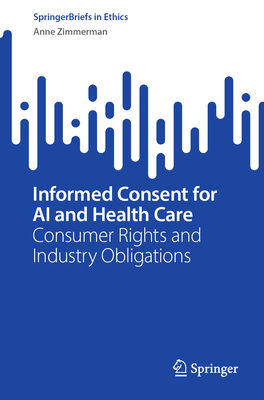
Informed Consent for AI and Health Care: Consumer Rights and Industry Obligations
暫譯: 人工智慧與醫療的知情同意:消費者權益與產業責任
Zimmerman, Anne
相關主題


商品描述
This book clarifies the differing roles of informed consent in healthcare as well as the guidelines, rules, and laws governing consent. The growing use of AI in health care has led to open questions about disclosure to the public as well as to healthcare consumers. There is no universal right to know whether or how AI is used in health care. The traditional right to informed consent requires disclosure of information, often based on what a reasonable person would use to make healthcare decisions, such as the risk of debilitating side effects. The system of informed consent as disclosure, understanding, and acquiescence as commonly used in patient care differs from the informed consent to release one's data, which is governed by a web of privacy laws. Furthermore, disclosure of the role of AI in drug discovery or in medical records brings different concerns for which the traditional patient-centered informed consent is insufficient or inapplicable. It may be ethically satisfactory to disclose the use of AI for the sake of transparency when the use of AI is unlikely to be considered in the healthcare consumer's decision making. By providing a simple explainer of medical AI, a brief history of informed consent, and arguments for the use of informed consent and against it, this book recommends using informed consent in health care, especially when a clinician is likely to unduly rely on an AI tool that poses risk. This book explores what healthcare consumers and the public should know and why. It is of interest to scholars and professionals navigating the growing use of AI in healthcare.
商品描述(中文翻譯)
本書闡明了知情同意在醫療保健中的不同角色,以及管理同意的指導方針、規則和法律。隨著人工智慧(AI)在醫療保健中的日益使用,對於向公眾和醫療消費者披露的問題產生了許多未解的疑問。並不存在普遍的權利來了解AI在醫療保健中是否以及如何被使用。傳統的知情同意權要求披露信息,通常基於合理人所使用的資訊來做出醫療決策,例如癱瘓性副作用的風險。作為披露、理解和默許的知情同意系統,與針對釋放個人數據的知情同意有所不同,後者受到一系列隱私法律的約束。此外,披露AI在藥物發現或醫療記錄中的角色帶來了不同的擔憂,傳統以病人為中心的知情同意在這些情況下是不足或不適用的。在AI的使用不太可能影響醫療消費者的決策時,為了透明度而披露AI的使用可能在倫理上是令人滿意的。本書提供了醫療AI的簡單解釋、知情同意的簡要歷史,以及支持和反對使用知情同意的論點,建議在醫療保健中使用知情同意,特別是當臨床醫生可能過度依賴一個存在風險的AI工具時。本書探討了醫療消費者和公眾應該知道什麼以及為什麼知道。對於在醫療保健中日益使用AI的學者和專業人士來說,這本書具有重要的參考價值。
作者簡介
Anne Zimmerman, JD, MS, CIPP-US (Certified Information Privacy Professional), CEET (Certified Ethical Emerging Technologist) is a Lecturer in AI & Ethics, Columbia University; Editor-in-Chief of Voices in Bioethics (Columbia University journal and podcast); Advisory Board Member, Columbia University Master of Science in Bioethics Program; Chair of the New York City Bar Association Bioethical Issues Committee; Co-Chair, AI and Healthcare Subcommittee of the New York City Bar Association Presidential Task Force on Artificial Intelligence and Digital Technologies; Editor, Digital Society Topical Collection "Exploring technologies as a social determinant of health;" Co-Founder and Chair of Innovative Bioethics Forum; Consultant to MyBioethics (ed-tech app); a Spring 2023 Colorado College Innovator in Residence; and a mentor for All Tech Is Human. Her book, Medicalization: An Encroachment on Consent, Culture, examines the phenomenon of medicalization and the increasingly large, invasive, and coercive role of medicine in society. Her previous book, Medicine, Power, and the Law: Exploring a Pipeline to Injustice explores the relationships between medicine, science, and technology and the criminal and civil justice systems.
作者簡介(中文翻譯)
安妮·齊默曼(Anne Zimmerman),法學博士(JD)、碩士(MS)、美國資訊隱私專業人員認證(CIPP-US)、認證倫理新興技術專家(CEET),是哥倫比亞大學人工智慧與倫理的講師;《生物倫理學之聲》(Voices in Bioethics,哥倫比亞大學期刊及播客)的主編;哥倫比亞大學生物倫理碩士課程的諮詢委員會成員;紐約市律師公會生物倫理議題委員會的主席;紐約市律師公會人工智慧與數位技術總統工作小組的人工智慧與醫療子委員會共同主席;數位社會主題集《探索技術作為健康的社會決定因素》的編輯;創新生物倫理論壇的共同創辦人及主席;MyBioethics(教育科技應用)的顧問;2023年春季科羅拉多學院的創新駐校專家;以及All Tech Is Human的導師。她的著作《醫療化:對同意與文化的侵擾》(Medicalization: An Encroachment on Consent, Culture)探討醫療化現象及醫學在社會中日益增長、侵入性和強制性的角色。她的前一本書《醫學、權力與法律:探索不公正的管道》(Medicine, Power, and the Law: Exploring a Pipeline to Injustice)探討醫學、科學與技術與刑事及民事司法系統之間的關係。