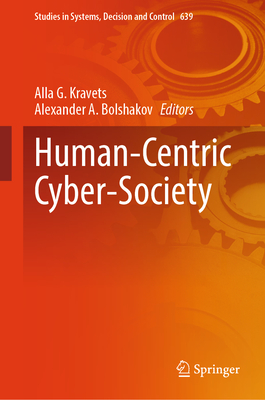
Human-Centric Cyber-Society
暫譯: 以人為本的網路社會
Kravets, Alla G., Bolshakov, Alexander A.
- 出版商: Springer
- 出版日期: 2026-01-03
- 售價: $7,550
- 貴賓價: 9.5 折 $7,172
- 語言: 英文
- 頁數: 278
- 裝訂: Hardcover - also called cloth, retail trade, or trade
- ISBN: 3032067863
- ISBN-13: 9783032067869
-
相關分類:
管理與領導 Management-leadership、Machine Learning
海外代購書籍(需單獨結帳)
相關主題

商品描述
This book seeks to examine the profound transformations brought about by the convergence of human-centered principles and advancing cyber-technologies across diverse fields, including industry, environment, healthcare, and interactive media. Each chapter contributes to a broader understanding of how technological progress influences and shapes our social, economic, and ecological landscapes. Part I of the book focuses on the emergence of human-centricity in flexible industries and organizations. The formation of human-centric approaches in management strategies ensures that businesses remain adaptable to rapid changes while maintaining a focus on people. The incorporation of digital configurations allows for greater control over complex organizational systems, fostering flexibility and responsiveness. Additionally, models like Haken's framework help assess socio-economic conditions, enabling regions to make informed decisions about growth and sustainability. The influence of market dynamics, particularly the effects of demand and cost fluctuations in oligopolistic markets, underscores the complexity of contemporary business ecosystems. Moreover, optimization techniques such as those employed in airline crew scheduling demonstrate the potential for enhanced efficiency when driven by advanced algorithms. Finally, the creation of cargo port risk management models illustrates how technology can mitigate systemic vulnerabilities. In Part II, attention shifts to environmental and ecological challenges. Multidimensional statistical tools analyze agricultural productivity, while small data sample modeling aids in optimizing resource-intensive processes like floodwater management. Innovative machine learning methods further refine the prediction of river flows and other hydrological phenomena. Simulations of fine dust particle dynamics provide deeper insights into atmospheric turbulence, while analyses of vehicular emissions shed light on urban pollution patterns. Part III turns to healthcare innovations, highlighting the role of machine learning in detecting breast cancer risks. Features derived from diagnostic models enhance the precision of detection, and cyber-physical systems leverage thermographic imagery to predict malignancies with greater accuracy.
商品描述(中文翻譯)
本書旨在探討人本原則與先進網路科技在各個領域(包括工業、環境、醫療保健和互動媒體)交匯所帶來的深刻變革。每一章節都有助於更廣泛地理解技術進步如何影響並塑造我們的社會、經濟和生態環境。本書的第一部分專注於人本主義在靈活產業和組織中的出現。管理策略中人本方法的形成確保企業在快速變化中保持適應性,同時專注於人員。數位配置的納入使得對複雜組織系統的控制更為強大,促進了靈活性和反應能力。此外,像 Haken 的框架這樣的模型有助於評估社會經濟條件,使地區能夠就增長和可持續性做出明智的決策。市場動態的影響,特別是在寡頭市場中需求和成本波動的影響,突顯了當代商業生態系統的複雜性。此外,像航空公司機組人員排班中使用的優化技術展示了在先進算法驅動下提高效率的潛力。最後,貨運港口風險管理模型的創建說明了技術如何減輕系統性脆弱性。在第二部分中,重點轉向環境和生態挑戰。多維統計工具分析農業生產力,而小數據樣本建模有助於優化如洪水管理等資源密集型過程。創新的機器學習方法進一步精煉了河流流量和其他水文現象的預測。細懸浮微粒動力學的模擬提供了對大氣湍流的更深入見解,而對車輛排放的分析則揭示了城市污染模式。第三部分轉向醫療保健創新,強調機器學習在檢測乳腺癌風險中的作用。從診斷模型中衍生的特徵提高了檢測的精確性,而網路物理系統利用熱成像技術以更高的準確性預測惡性腫瘤。