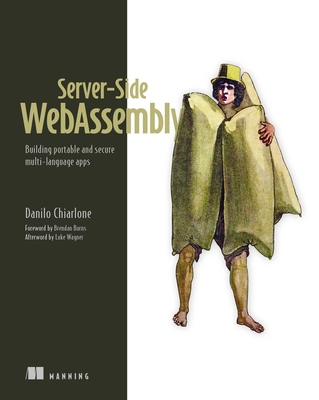
Server-Side Webassembly: Building Portable and Secure Multi-Language Apps (Paperback)
暫譯: 伺服器端 WebAssembly:構建可攜帶且安全的多語言應用程式(平裝本)
Chiarlone, Danilo
- 出版商: Manning
- 出版日期: 2025-12-30
- 售價: $1,840
- 貴賓價: 9.5 折 $1,748
- 語言: 英文
- 頁數: 272
- 裝訂: Quality Paper - also called trade paper
- ISBN: 1633436209
- ISBN-13: 9781633436206
-
相關分類:
WebAssembly
立即出貨 (庫存 < 3)
買這商品的人也買了...
-
 Arduino 官方正版 Genuino 101
$1,700$1,700 -
 Raspberry Pi 3 Model B+ (UK製)
$1,720$1,685 -
 晉昇軟體最高殿堂:Jenkins2 持續整合大師之路
$600$474 -
 $1,320Deep Learning with JavaScript: Neural Networks in Tensorflow.Js
 -
 JavaScript 技術手冊
$560$476 -
 $1,584Microservices Security in Action
 -
 Principles of Distributed Database Systems, 4/e (Paperback)
$2,500$2,375 -
 $1,840Multithreaded JavaScript: Concurrency Beyond the Event Loop
 -
 Understanding Distributed Systems : What every developer should know about large distributed applications, 2/e (Paperback)
$1,650$1,617 -
 Understanding Deep Learning (Hardcover)
$2,150$2,107 -
 OpenTelemetry 入門指南:建立全面可觀測性架構(iThome鐵人賽系列書)【軟精裝】(封面有些許摺痕,不介意在下單)
$750$585 -
 內行人才知道的機器學習系統設計面試指南 (Machine Learning System Design Interview)
$680$537 -
 簡約的軟體開發思維:用 Functional Programming 重構程式 - 以 Javascript 為例 (Grokking Simplicity: Taming Complex Software with Functional Thinking)
$1,000$850 -
 $2,106Full Stack JavaScript Strategies: The Hidden Parts Every Mid-Level Developer Needs to Know (Paperback)
 -
 問 ChatGPT 也不會的 Python 量化交易聖經 - 從分析到真實交易一本全會
$880$695 -
 $1,728AI Agents in Action (Paperback)
 -
 $1,836Cloud Application Architecture Patterns: Designing, Building, and Modernizing for the Cloud (Paperback)
 -
 $2,205Beyond Vibe Coding: From Coder to Ai-Era Developer (Paperback)
 -
 Docker 建置與執行, 3/e (Docker: Up & Running: Shipping Reliable Containers in Production, 3/e)
$880$695 -
 $2,205Building Event-Driven Microservices: Leveraging Organizational Data at Scale
 -
 Latency: Reduce Delay in Software Systems (Paperback)
$2,260$2,147 -
 Just Use Postgres!: All the Database You Need (Paperback)
$2,260$2,147 -
 $2,520Transformers: The Definitive Guide: Applications Beyond NLP (Paperback)
 -
 $2,484Rag with Python Cookbook: Practical Recipes from Data Preprocessing to LLM Agents (Paperback)
 -
 從 AI Agent 到多代理人系統設計|架構規劃與應用開發 (Building Applications with AI Agents: Designing and Implementing Multiagent Systems)
$780$616
相關主題

商品描述
Get a free eBook (PDF or ePub) from Manning as well as access to the online liveBook format (and its AI assistant that will answer your questions in any language) when you purchase the print book.
"WebAssembly on the server is the future of computing."
-Solomon Hykes, founder of Docker
Learn how to harness the power of Wasm on the application back-end. By following the numerous practical examples and crystal-clear explanations, you'll soon be seeing the benefits of reduced cold start times, improved security and performance, and the freedom of polyglot programming.
This book lays out everything you need to take WebAssembly beyond its traditional browser domain. You'll put on the hats of a systems architect, a backend developer, and even a DevOps engineer to get a full picture of WebAssembly development from both an architecture and development perspective.
Inside Server-Side WebAssembly you'll learn how to:
- Develop and deploy server-side Wasm applications
- Create and manage Wasm containers with OCI
- Compile Wasm components from multiple languages
- Scale Wasm applications using Kubernetes
- Deploy Wasm applications across different environments
- Integrate with databases and machine learning
About the technology
WebAssembly (Wasm) revolutionized frontend development by enabling secure, high-performance code in the browser. Now it's doing the same for backend infrastructure as a platform for lightweight, portable applications that run anywhere. In this book, you'll learn how to build production-grade server-side apps using Wasm.
About the book
Server-Side WebAssembly teaches you to use WebAssembly components and the WebAssembly System Interface (WASI) to build web back ends. You'll start with Wasm fundamentals and then quickly start building a realistic content management system complete with data storage, HTTP servers, and AI-generated content. As you go, you'll see how Wasm integrates code from multiple languages and connects naturally with databases, AI/ML systems, and deployment platforms like Kubernetes.
What's inside
- Integrate components from multiple languages
- Deploy Wasm applications on Kubernetes
- Connect Wasm apps to databases and ML systems
About the reader
For intermediate web developers. Code samples in Rust, JavaScript and Python.
About the author
Danilo Chiarlone works at Microsoft on cloud and virtualization technologies and is a contributor to several WebAssembly System Interface (WASI) proposals.
Table of Contents
Part 1
1 Introducing Wasm on the server
2 Building server-side applications with Wasm modules
3 Enhancing portability and security with Wasm components
4 Interfacing Wasm with the underlying system
5 From machine learning to databases: Applications of Wasm
Part 2
6 Creating production-grade Wasm applications
7 Introducing Wasm containers
8 Scalability for Wasm with Kubernetes
9 The future of Wasm
A Required tools
B Deploying the SmartCMS to Azure Kubernetes Service
商品描述(中文翻譯)
購買印刷書籍時,您將獲得 Manning 提供的免費電子書(PDF 或 ePub),以及在線 liveBook 格式的訪問權限(及其 AI 助手,能以任何語言回答您的問題)。
「伺服器上的 WebAssembly 是計算的未來。」
- Solomon Hykes,Docker 創始人
學習如何在應用程式後端利用 Wasm 的力量。通過眾多實用範例和清晰的解釋,您將很快看到減少冷啟動時間、提高安全性和性能,以及多語言編程的自由所帶來的好處。
本書詳細介紹了將 WebAssembly 擴展到其傳統瀏覽器領域之外所需的一切。您將扮演系統架構師、後端開發人員,甚至是 DevOps 工程師的角色,從架構和開發的角度全面了解 WebAssembly 的開發。
在 伺服器端 WebAssembly 中,您將學習如何:
- 開發和部署伺服器端 Wasm 應用程式
- 使用 OCI 創建和管理 Wasm 容器
- 從多種語言編譯 Wasm 組件
- 使用 Kubernetes 擴展 Wasm 應用程式
- 在不同環境中部署 Wasm 應用程式
- 與資料庫和機器學習整合
關於技術
WebAssembly (Wasm) 通過在瀏覽器中啟用安全、高效能的代碼,徹底改變了前端開發。現在,它同樣為後端基礎設施提供了一個輕量級、可攜帶的應用程式平台,能在任何地方運行。在本書中,您將學習如何使用 Wasm 構建生產級的伺服器端應用程式。
關於本書
伺服器端 WebAssembly 教您使用 WebAssembly 組件和 WebAssembly 系統介面 (WASI) 來構建網頁後端。您將從 Wasm 基礎開始,然後迅速構建一個完整的內容管理系統,包含數據存儲、HTTP 伺服器和 AI 生成的內容。在此過程中,您將看到 Wasm 如何整合來自多種語言的代碼,並自然地與資料庫、AI/ML 系統及 Kubernetes 等部署平台連接。
內容概覽
- 整合來自多種語言的組件
- 在 Kubernetes 上部署 Wasm 應用程式
- 將 Wasm 應用程式連接到資料庫和 ML 系統
關於讀者
適合中級網頁開發人員。代碼範例使用 Rust、JavaScript 和 Python。
關於作者
Danilo Chiarlone 在 Microsoft 從事雲端和虛擬化技術的工作,並為幾個 WebAssembly 系統介面 (WASI) 提案做出貢獻。
目錄
第一部分
1 介紹伺服器上的 Wasm
2 使用 Wasm 模組構建伺服器端應用程式
3 通過 Wasm 組件增強可攜性和安全性
4 將 Wasm 與底層系統介面連接
5 從機器學習到資料庫:Wasm 的應用
第二部分
6 創建生產級的 Wasm 應用程式
7 介紹 Wasm 容器
8 使用 Kubernetes 擴展 Wasm 的可擴展性
9 Wasm 的未來
A 所需工具
B 將 SmartCMS 部署到 Azure Kubernetes Service
作者簡介
Danilo Chiarlone is a champion of multiple WebAssembly System Interface Proposals, and has made significant contributions to WebAssembly with his work on projects like SpiderLightning and runwasi. Danilo is also a passionate educator, offering free lessons on Rust and WebAssembly through his YouTube channel and delivering multiple presentations at events such as CloudNative Rejekts, WasmCon, and RustGlobal. Danilo works at Microsoft, where he focuses on increasing WebAssembly security through hardware virtualization and enabling the next wave of serverless and edge computing applications.
作者簡介(中文翻譯)
Danilo Chiarlone 是多個 WebAssembly 系統介面提案的倡導者,並且在 WebAssembly 領域做出了重要貢獻,參與了 SpiderLightning 和 runwasi 等專案。Danilo 也是一位熱情的教育者,通過他的 YouTube 頻道提供免費的 Rust 和 WebAssembly 課程,並在 CloudNative Rejekts、WasmCon 和 RustGlobal 等活動中進行多次演講。Danilo 在微軟工作,專注於通過硬體虛擬化提高 WebAssembly 的安全性,並促進下一波無伺服器和邊緣計算應用的發展。