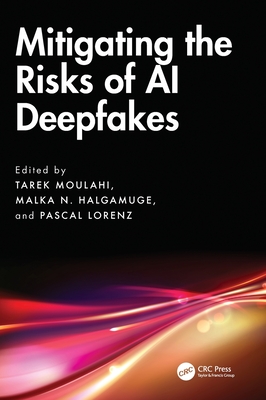
Mitigating the Risks of AI Deepfakes
暫譯: 減輕AI深偽技術的風險
Moulahi, Tarek, Halgamuge, Malka N., Lorenz, Pascal
- 出版商: CRC
- 出版日期: 2026-04-30
- 售價: $5,630
- 貴賓價: 9.5 折 $5,348
- 語言: 英文
- 頁數: 264
- 裝訂: Hardcover - also called cloth, retail trade, or trade
- ISBN: 103282350X
- ISBN-13: 9781032823508
-
相關分類:
DeepLearning
海外代購書籍(需單獨結帳)
相關主題

商品描述
Artificial intelligence (AI) has become deeply embedded in modern life, with autonomous systems now controlling many crucial functions in healthcare, transportation, and industry. However, the incredible power of AI also enables new forms of manipulation, deception, and harm. In our proposed book "Safeguarding Our Digital Future: Mitigating the Risks of AI Deepfakes," the chapters explore the dark side of AI and its dangerous implications for human wellbeing.
Spanning over 250 pages, the book examines how attackers can exploit AI systems to spread misinformation, steal identities, endanger lives through faulty diagnostics, and jeopardize public safety through products like self-driving cars. The chapters also dive into the national security risks posed by deepfakes and the use of AI to create compelling fake audio/video content used for political sabotage and blackmail. They explain how deepfakes could be uniquely disruptive in conservative societies that depend on reputation and visual evidence.
While increased reliance on AI delivers efficiency and insight, unchecked development poses catastrophic risks that outweigh the benefits. By assembling a comprehensive overview of the threats we face alongside potential solutions, this book sounds an alarm regarding the dark side of progress while laying out a blueprint for mitigating dangers. The chapters synthesize cutting-edge research on fighting back against AI manipulation through innovations in machine learning, deep learning, reinforcement learning, and federated learning.
Ultimately, "Mitigating the Risks of AI Deepfakes" serves as an essential call to action for consumers, companies, and governments to confront the hazards of AI proliferation head-on. If left unaddressed, the sinister potential of systems we depend on could endanger civil liberties and human life. We must work proactively to guard the public interest as intelligent algorithms grow more advanced. This book equips readers with the knowledge to meet that challenge.
商品描述(中文翻譯)
人工智慧(AI)已深深融入現代生活,自主系統現在控制著醫療、交通和工業中的許多關鍵功能。然而,AI的驚人能力也使得新的操控、欺騙和傷害形式得以實現。在我們提議的書籍《保護我們的數位未來:減輕AI深度偽造的風險》中,各章節探討了AI的黑暗面及其對人類福祉的危險影響。
這本書超過250頁,檢視了攻擊者如何利用AI系統散播錯誤資訊、盜竊身份、透過錯誤診斷危及生命,以及透過自駕車等產品危害公共安全。各章節還深入探討了深度偽造所帶來的國家安全風險,以及利用AI創造引人注目的假音頻/視頻內容進行政治破壞和勒索的情況。它們解釋了深度偽造在依賴聲譽和視覺證據的保守社會中可能造成的獨特破壞。
雖然對AI的依賴增加帶來了效率和洞察力,但不受控制的發展則帶來了超過其好處的災難性風險。通過彙編我們面臨的威脅及潛在解決方案的全面概述,這本書對進步的黑暗面發出警報,同時提出減輕危險的藍圖。各章節綜合了針對AI操控的反擊前沿研究,涵蓋機器學習、深度學習、強化學習和聯邦學習的創新。
最終,《減輕AI深度偽造的風險》作為一個重要的行動呼籲,促使消費者、公司和政府正視AI擴散的危險。如果不加以處理,我們所依賴的系統的險惡潛力可能危及公民自由和人類生命。我們必須主動工作以保護公共利益,隨著智能算法的日益進步。這本書為讀者提供了應對這一挑戰的知識。
作者簡介
Dr Tarek Moulahi received his Ph.D. in Computer Science through a joint doctoral program between the University of Franche-Comté (Besançon, France) and the National School of Engineering of Sfax (Tunisia), which he completed on March 6, 2015. He is currently an Associate Professor in the Department of Mathematics and Computer Science at the Faculty of Science and Technology of Sidi Bouzid, University of Kairouan (Tunisia), and in the Department of Information Technology at the College of Computer, Qassim University (Saudi Arabia).
His research interests initially focused on Wireless Sensor Networks, the subject of both his Master's and Ph.D. theses. After his doctorate, his work expanded to include Vehicular Ad Hoc Networks (VANETs), Artificial Intelligence applications, and lightweight blockchain techniques for IoT systems. He currently supervises several Master's and Ph.D. students and has published numerous papers in high-impact international journals and conferences.
Dr Malka N. Halgamuge is a Senior Lecturer in Cybersecurity at RMIT University, Melbourne, Australia. She currently serves as Chair of the IEEE Computational Intelligence Society (Victorian Section) and Vice Chair of the IEEE Victorian Section, Australia. From 2007-2021, Malka worked as a Researcher at the Department of Electrical and Electronic Engineering at the University of Melbourne. She obtained her PhD in the same department. She was awarded prestigious fellowships: Australia-China Young Scientist Fellow (China), Dyason Fellow (UCLA), Chinese Academy of Sciences (CAS) President's International Fellow (Beijing), Solander Fellow (Sweden), Incoming Leaders Fellow (Australia India Institute, Delhi), Next Step Initiative Fellow (China). Malka was the Keynote Speaker (ICEMI'25, ICACMVE'23, EcoSSSoil'19, EPR'18), Plenary Speaker (IEEEPowerCon'24, AIBC'24, ICBET'18), Associate Editor, Editorial Board Member, and IEEE Senior Member. She was the Program Co-Chair, Track Chair, Publication Chair, Advisory Chair, Publicity Co-Chair, Session Chair, Guest Editor, and a Member of the TPC for 300 international conferences. She has presented 60 invited/guest lectures in academia (e.g., Oxford University, Ohio State University), industry, and at 10 IEEE sections. Malka has conducted 18 media interviews, articles, radio interviews, and TV interviews (ABC News). She is passionate about research in IoT, data communications, cybersecurity, AI applications, and LLMs security and their energy efficiency. She has co-supervised 4 PhD students to completion at the University of Melbourne as the principal supervisor and currently supervises 10 PhD students at RMIT University. Malka has been a chief investigator for multiple grants totalling over $2 million and has over 120 peer-reviewed publications in scientific journals and conference proceedings. She has been consecutively listed among the top 2% of the world's most cited researchers (Stanford University database, 2020-2025).
Dr Pascal Lorenz received his M.Sc. (1990) and Ph.D. (1994) from the University of Nancy, France. Between 1990 and 1995 he was a research engineer at WorldFIP Europe and at Alcatel-Alsthom. He is a professor at the University of Haute-Alsace, France, since 1995. His research interests include QoS, wireless networks and high-speed networks. He is the author/co-author of 3 books, 3 patents and 200 international publications in refereed journals and conferences. He was Technical Editor of the IEEE Communications Magazine Editorial Board (2000-2006), IEEE Networks Magazine since 2015, IEEE Transactions on Vehicular Technology since 2017, Chair of IEEE ComSoc France (2014-2020), Financial chair of IEEE France (2017-2022), Chair of Vertical Issues in Communication Systems Technical Committee Cluster (2008-2009), Chair of the Communications Systems Integration and Modeling Technical Committee (2003-2009), Chair of the Communications Software Technical Committee (2008-2010) and Chair of the Technical Committee on Information Infrastructure and Networking (2016-2017), Chair of IEEE/ComSoc Satellite and Space Communications Technical (2022-2023), IEEE R8 Finance Committee (2022-2023), IEEE R8 Conference Coordination Committee (2023). He has served as Co-Program Chair of IEEE WCNC'2012 and ICC'2004, Executive Vice-Chair of ICC'2017, TPC Vice Chair of Globecom'2018, Panel sessions co-chair for Globecom'16, tutorial chair of VTC'2013 Spring and WCNC'2010, track chair of PIMRC'2012 and WCNC'2014, symposium Co-Chair at Globecom 2007-2011, Globecom'2019, ICC 2008-2010, ICC'2014 and '2016. He has served as Co-Guest Editor for special issues of IEEE Communications Magazine, Networks Magazine, Wireless Communications Magazine, Telecommunications Systems and LNCS. He is associate Editor for International Journal of Communication Systems (IJCS-Wiley), Journal on Security and Communication Networks (SCN-Wiley) and International Journal of Business Data Communications and Networking, Journal of Network and Computer Applications (JNCA-Elsevier). He is senior member of the IEEE, IARIA fellow and member of many international program committees. He has organized many conferences, chaired several technical sessions and gave tutorials at major international conferences. He was IEEE ComSoc Distinguished Lecturer Tour during 2013-2014.
作者簡介(中文翻譯)
塔瑞克·穆拉希博士於2015年3月6日通過法國弗朗什-孔泰大學(Besançon, France)和突尼西亞斯法克斯國立工程學院的聯合博士計畫獲得計算機科學博士學位。他目前是突尼西亞凱魯萬大學科學與技術學院數學與計算機科學系的副教授,以及沙烏地阿拉伯卡西姆大學計算機學院資訊技術系的副教授。他的研究興趣最初集中在無線感測器網路,這也是他碩士和博士論文的主題。在獲得博士學位後,他的研究擴展到車輛自組網(VANETs)、人工智慧應用以及物聯網系統的輕量級區塊鏈技術。目前,他指導多位碩士和博士生,並在高影響力的國際期刊和會議上發表了多篇論文。
馬爾卡·N·哈爾甘穆格博士是澳大利亞墨爾本RMIT大學的網路安全高級講師。她目前擔任IEEE計算智能學會(維多利亞分會)主席及IEEE維多利亞分會副主席。從2007年至2021年,馬爾卡在墨爾本大學電氣與電子工程系擔任研究員,並在同一系獲得博士學位。她獲得了多項著名獎學金:澳中青年科學家獎(中國)、戴森獎學金(UCLA)、中國科學院(CAS)院長國際獎學金(北京)、索蘭德獎學金(瑞典)、未來領袖獎學金(澳大利亞印度研究所,德里)、下一步倡議獎學金(中國)。馬爾卡曾擔任多個會議的主題演講者(ICEMI'25、ICACMVE'23、EcoSSSoil'19、EPR'18)、全體會議演講者(IEEEPowerCon'24、AIBC'24、ICBET'18)、副編輯、編輯委員會成員及IEEE高級會員。她曾擔任300個國際會議的程序共同主席、專題主席、出版主席、顧問主席、宣傳共同主席、會議主席、特邀編輯及技術程序委員會成員。她在學術界(例如牛津大學、俄亥俄州立大學)、業界及10個IEEE分會中發表了60場受邀/特邀講座。馬爾卡進行了18次媒體訪談,包括文章、廣播訪談及電視訪談(ABC新聞)。她對物聯網、數據通信、網路安全、人工智慧應用及大型語言模型的安全性及其能效充滿熱情。她在墨爾本大學作為主要指導教授共同指導了4位博士生完成學業,並目前在RMIT大學指導10位博士生。馬爾卡是多個總額超過200萬美元的研究計畫的首席研究員,並在科學期刊和會議論文集中發表了超過120篇經過同行評審的論文。她連續被列入全球最被引用研究人員的前2%(斯坦福大學數據庫,2020-2025)。
帕斯卡·洛倫茲博士於1990年獲得法國南錫大學的碩士學位,並於1994年獲得博士學位。1990年至1995年間,他在WorldFIP Europe和阿爾卡特-阿爾斯通擔任研究工程師。自1995年以來,他一直是法國上阿爾薩斯大學的教授。他的研究興趣包括服務質量(QoS)、無線網路和高速網路。他是3本書籍、3項專利及200篇國際期刊和會議的共同作者。他曾擔任IEEE通訊雜誌編輯委員會的技術編輯(2000-2006)、IEEE Networks雜誌的編輯(自2015年起)、IEEE車輛技術學報的編輯(自2017年起)、IEEE通訊學會法國分會主席(2014-2020)、IEEE法國財務主席(2017-2022)、通訊系統技術委員會垂直議題集群主席(2008-2009)、通訊系統整合與建模技術委員會主席(2003-2009)、通訊軟體技術委員會主席(2008-2010)及資訊基礎設施與網路技術委員會主席(2016-2017)、IEEE/ComSoc衛星與太空通訊技術委員會主席(2022-2023)、IEEE R8財務委員會(2022-2023)、IEEE R8會議協調委員會(2023)。他曾擔任IEEE WCNC'2012和ICC'2004的共同程序主席,ICC'2017的執行副主席,Globecom'2018的TPC副主席,Globecom'16的專題會議共同主席,VTC'2013春季和WCNC'2010的教程主席,PIMRC'2012和WCNC'2014的專題主席,Globecom 2007-2011、Globecom'2019、ICC 2008-2010、ICC'2014和'2016的研討會共同主席。他曾擔任IEEE通訊雜誌、Networks雜誌、無線通訊雜誌、電信系統及LNCS的特刊共同編輯。他是《國際通訊系統期刊》(IJCS-Wiley)、《安全與通訊網路期刊》(SCN-Wiley)及《國際商業數據通訊與網路期刊》、《網路與計算機應用期刊》(JNCA-Elsevier)的副編輯。他是IEEE的高級會員、IARIA的研究員及多個國際程序委員會的成員。他組織了多個會議,主持了幾個技術會議並在主要國際會議上進行了教程。他曾於2013-2014年期間擔任IEEE通訊學會傑出講者巡迴演講。